

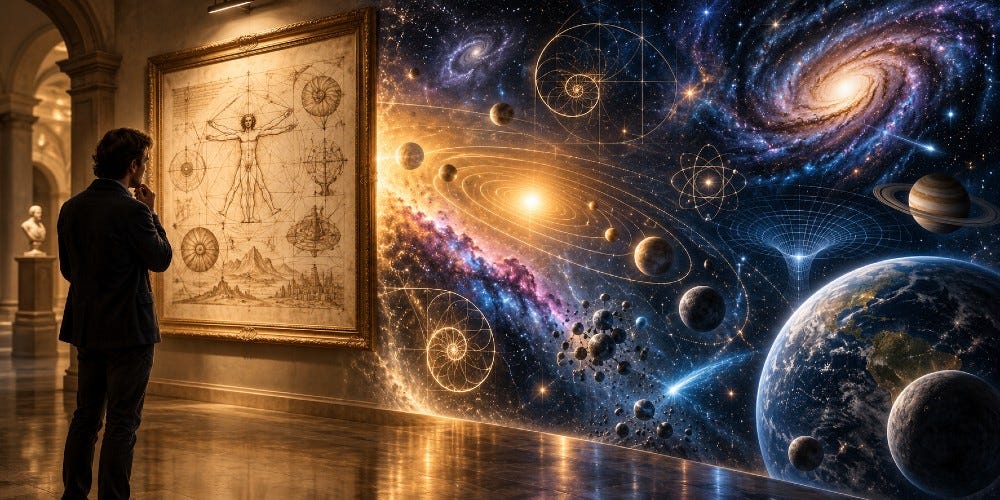
A former atheist walked into a quiet gallery at the Getty, stood inches from a Leonardo sketch, and did not for one second believe the lines had arranged themselves. Years later he looked at gravity, the charge of the electron, and the size of the observable universe and reached the same conclusion. The cosmos is not a lucky pile of numbers. It is a work of genius.
That is the argument physicist and former ABC News science editor Michael Guillén laid out at Fox News last week. He spent years treating science as god and the universe as a miraculous accident. He does not treat it that way anymore. The numbers will not let him, just as they would not allow any thinking human being who looks at them. And Guillén is not just any thinking human being.
The Coincidences That Will Not Go Away
In 1973, scientists gathered in Kraków to mark Copernicus’s 500th birthday and ran into an old embarrassment they called the “large-number coincidences.” The radius of the observable universe, the strength of gravity, the charge of an electron, and a stack of other measured values sit in a pattern that looks nothing like chance.
Australian physicist Brandon Carter stood up and said the quiet part out loud. Those numbers are tied to the one thing that makes this universe interesting. Us. Life. Without living creatures, the whole show is an empty warehouse.
Carter’s remark became the Anthropic Principle, and it detonated a field that is still inexplicably trying to decide whether the universe is a coincidence or a construction. Guillén’s analogy is rock solid. A nurse takes four vital signs and learns what is happening inside a body. The universe has vital signs too. After decades of tighter measurements and harder calculations, those signs do not read “accident.”
Even men who wanted no part of church language admitted it. The late cosmologist Allan Sandage, once an atheist himself, said he found it “quite improbable that such order came out of chaos” and that “there has to be some organizing principle.”
British astronomer Sir Fred Hoyle, whom Guillén knew as a graduate student at Cornell, went further.
A commonsense interpretation of the facts suggests that a super-intellect has monkeyed with physics… and that there are no blind forces worth speaking about in nature. The numbers one calculates from the facts seem to me so overwhelming as to put this conclusion almost beyond question.
Hoyle spent a career trying to keep God out of the laboratory. Carbon’s energy levels still cornered him. The triple-alpha process that forges the carbon in your bones sits on a razor so thin that Hoyle himself called the result a super-intellect monkeying with physics. Stephen Meyer has walked that same trail from the beginning of the universe to the information in DNA and arrived at the same door.
A mind was here first.
The Escape Hatch That Does Not Open
Atheism’s problem is not a missing decimal. Its problem is the origin of the rules. You can chant “purposeless laws of nature” all day. You still have to explain where those laws came from, why they are mathematical, and why they happen to permit brains that can notice the math.
“It just is” is not an argument. It is a shrug in a lab coat.
The fashionable excuse is the multiverse. Invent infinite unseen universes, and ours becomes the winning lottery ticket you never had to buy. Convenient. Also untestable and therefore unfalsifiable. Parallel universes are isolated by definition. You cannot observe them, falsify them, or drag them into a lab.
German physicist Sabine Hossenfelder has said the quiet part here too. The idea that we live in a multiverse is, in her words, a fringe notion in a small corner of a subfield, and “nobody who does serious science works with the multiverse because it’s utterly useless.”
That is not a Sunday school talking point. That is a working physicist telling her own guild that they have dressed metaphysics in equations and called it research.
Robin Schumacher noted the comedy earlier this year. A survey of roughly 1,700 physicists, waved around as a refutation of design, actually conceded the fact of fine-tuning. The top answer was that the constants are “brute facts that need no further explanation.”
Intelligent design got 3 percent. The multiverse got 24. The winner was a refusal to explain. William Lane Craig’s response was the right one. Calling something a brute fact admits the fact and then denies that an explanation is required. That is not science. That is a man walking past a signed canvas and insisting no one held the brush.
Lee Strobel, another former atheist, made the same case in The Story of Everything. The universe began. Nature can spit out patterns. It cannot write information. And the life-permitting window is so narrow that chance is a sermon, not a calculation.
What the Heavens Keep Saying
The heavens declare the glory of God; and the firmament sheweth his handywork.
That line does not need a laboratory to be true, but the laboratory has not contradicted it. Gravity a hair stronger and stars burn out. A hair weaker and they never ignite. The cosmological constant sits off naive theoretical expectation by something like 120 orders of magnitude. Change the strong force a little and you lose carbon or you lock hydrogen into diprotons and chemistry dies in the crib.
This is not a God-of-the-gaps speech. This is the data refusing to play along with the dogma that nothing and no one is watching.
Even the Goldilocks language now comes from physicists, not pastors. The universe is “just right.” Dawkins promised blind, pitiless indifference. The instruments keep handing back calibration. You can feel the strain in the literature. The more precise the measurement, the more baroque the rescue story. Infinite worlds. Brute facts. Selection effects that explain why we notice we are alive. Anything but an Artist.
Creation is not a closed museum. The same hand that set the constants shows up in living things that still embarrass the accident narrative. Peacock feathers that lase. Cells that store libraries. A sky that can be read by the creatures it was built to hold. The materialist has to pretend all of that is weather.
It is not weather.
Guillén’s Getty story works because everyone already knows how to recognize design. You do not stand in front of a da Vinci and invent a trillion unseen galleries so that one sketch can be random. You credit the mind. The universe is the larger sketch. Gravity, electromagnetism, nuclear forces, and the first low-entropy state of the cosmos are the lines. They were placed. They hold. They permit a man to walk into a museum, remember he used to worship chance, and repent of the insult.
Atheism’s biggest question is not new. If this is not a coincidence, what is it? The honest answer has a name, and it is not a multiverse. In the beginning God created the heaven and the earth. The numbers agree with the first sentence. The only people still calling it luck are the ones who cannot afford the Artist.
To be saved from what you say “hell”” one must believe that Christ died for their sins, and that he was buried, and that he rose again the third day, 1Corinthians 15:1-4…This must be believed from the heart and not just head knowledge…
Love it JD! Well said, brother. God bless you!